Skill · Shadow Hand
Count fingers
Five pathways, one per finger. Each finger folds only while its own pathway is ON.
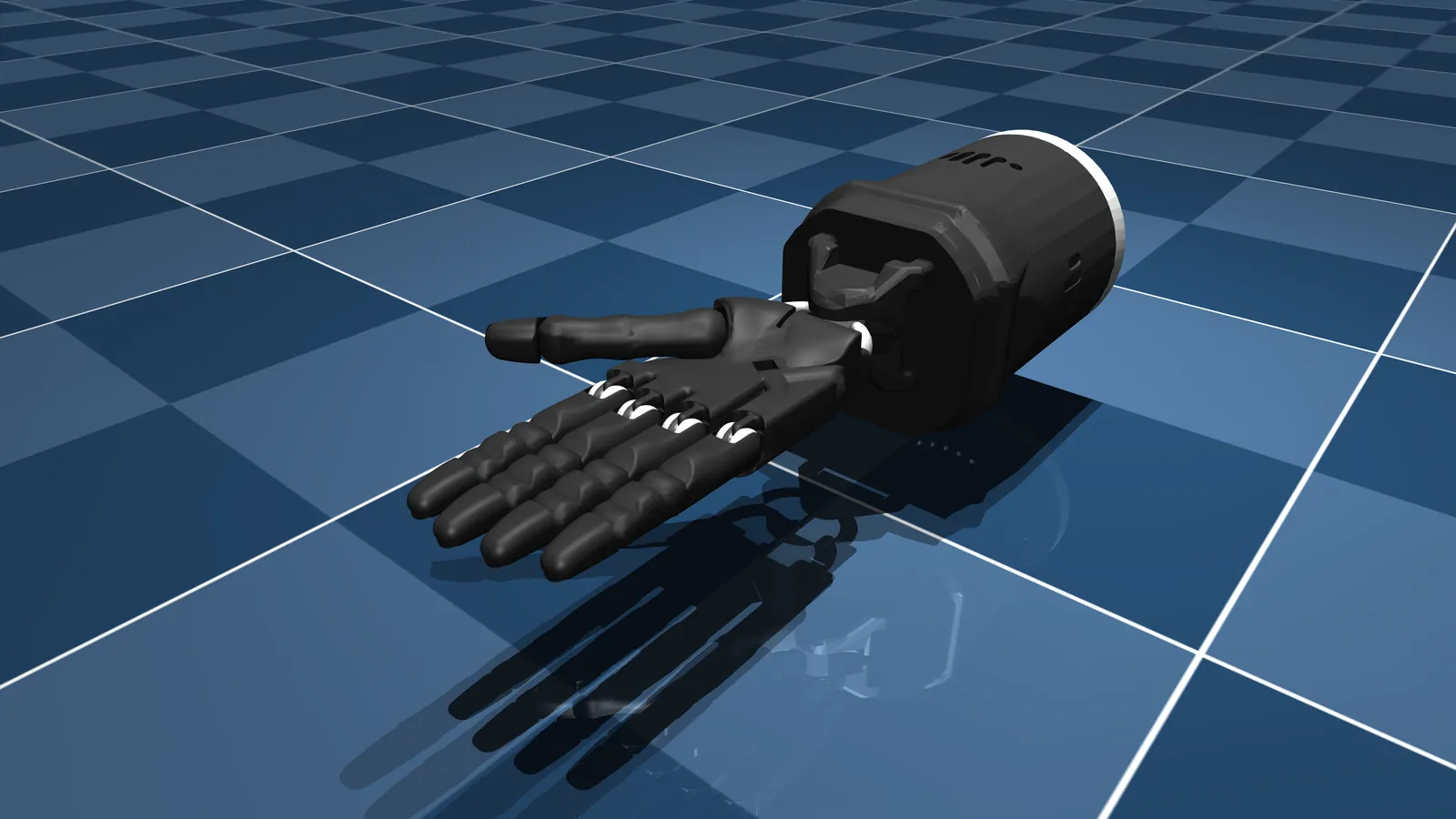
Runs on the Shadow Hand · Dexterous hand
01 Pathways
How the neurons drive it.
A pathway is one cue: the electrode we pulse, the electrodes we read, and the rule that decides when it is ON. This skill has five.
“thumb”
- Pulse electrode
- 11at 10 Hz
- Read electrodes
- 2 3 10 12 18 19
- ON at
- 0.6spikes per electrode per 100 ms
We pulse electrode 11 at 10 Hz. When electrodes 2, 3, 10, 12, 18 and 19 average at least 0.6 spikes per 100 ms, and twice the rate of the rest of the array, “thumb” is ON.
“index”
- Pulse electrode
- 14at 10 Hz
- Read electrodes
- 5 6 13 15 21 22 23
- ON at
- 0.6spikes per electrode per 100 ms
We pulse electrode 14 at 10 Hz. When electrodes 5, 6, 13, 15, 21, 22 and 23 average at least 0.6 spikes per 100 ms, and twice the rate of the rest of the array, “index” is ON.
“middle”
- Pulse electrode
- 33at 10 Hz
- Read electrodes
- 24 25 32 40 41 42
- ON at
- 0.6spikes per electrode per 100 ms
We pulse electrode 33 at 10 Hz. When electrodes 24, 25, 32, 40, 41 and 42 average at least 0.6 spikes per 100 ms, and twice the rate of the rest of the array, “middle” is ON.
“ring”
- Pulse electrode
- 53at 10 Hz
- Read electrodes
- 44 45 46 54 60 61 62
- ON at
- 0.6spikes per electrode per 100 ms
We pulse electrode 53 at 10 Hz. When electrodes 44, 45, 46, 54, 60, 61 and 62 average at least 0.6 spikes per 100 ms, and twice the rate of the rest of the array, “ring” is ON.
“little”
- Pulse electrode
- 58at 10 Hz
- Read electrodes
- 49 50 51 57 59
- ON at
- 0.6spikes per electrode per 100 ms
We pulse electrode 58 at 10 Hz. When electrodes 49, 50, 51, 57 and 59 average at least 0.6 spikes per 100 ms, and twice the rate of the rest of the array, “little” is ON.
These are the skill file’s starting electrodes, numbered column by column across the 8 × 8 array. Calibration moves each pathway onto electrodes your culture actually answers on and raises its ON threshold above resting noise.
02 Movement
What the Shadow Hand does.
Target pose “thumb”
- thumb flex
- 1.2 rad
- thumb bend
- 0.6 rad
- thumb tip
- 0.8 rad
Target pose “index”
- index flex
- 1.4 rad
- index curl
- 2.6 rad
Target pose “middle”
- middle flex
- 1.4 rad
- middle curl
- 2.6 rad
Target pose “ring”
- ring flex
- 1.4 rad
- ring curl
- 2.6 rad
Target pose “little”
- little flex
- 1.4 rad
- little curl
- 2.6 rad
03 The test
Moves only while cued.
Pulse thumb, index, middle, ring, little in turn (1.5 s each): each finger folds only in its own window.
It passes when
- 01Thumb folds in its window
- 02Thumb open in other windows
- 03Index folds in its window
- 04Index open in other windows
- 05Middle folds in its window
- 06Middle open in other windows
- 07Ring folds in its window
- 08Ring open in other windows
- 09Little folds in its window
- 10Little open in other windows
04 Proof
Proof it is the neurons.
Validation replays this test three times on the same spontaneous activity. The skill counts only if it passes with stimulation and fails under both controls; if it also passes without the neurons, it is marked invalid.
05 More skills
Shadow Hand
Train “Count fingers” on the Shadow Hand.
Choose a biocomputer, launch, and watch it calibrate, train and validate.